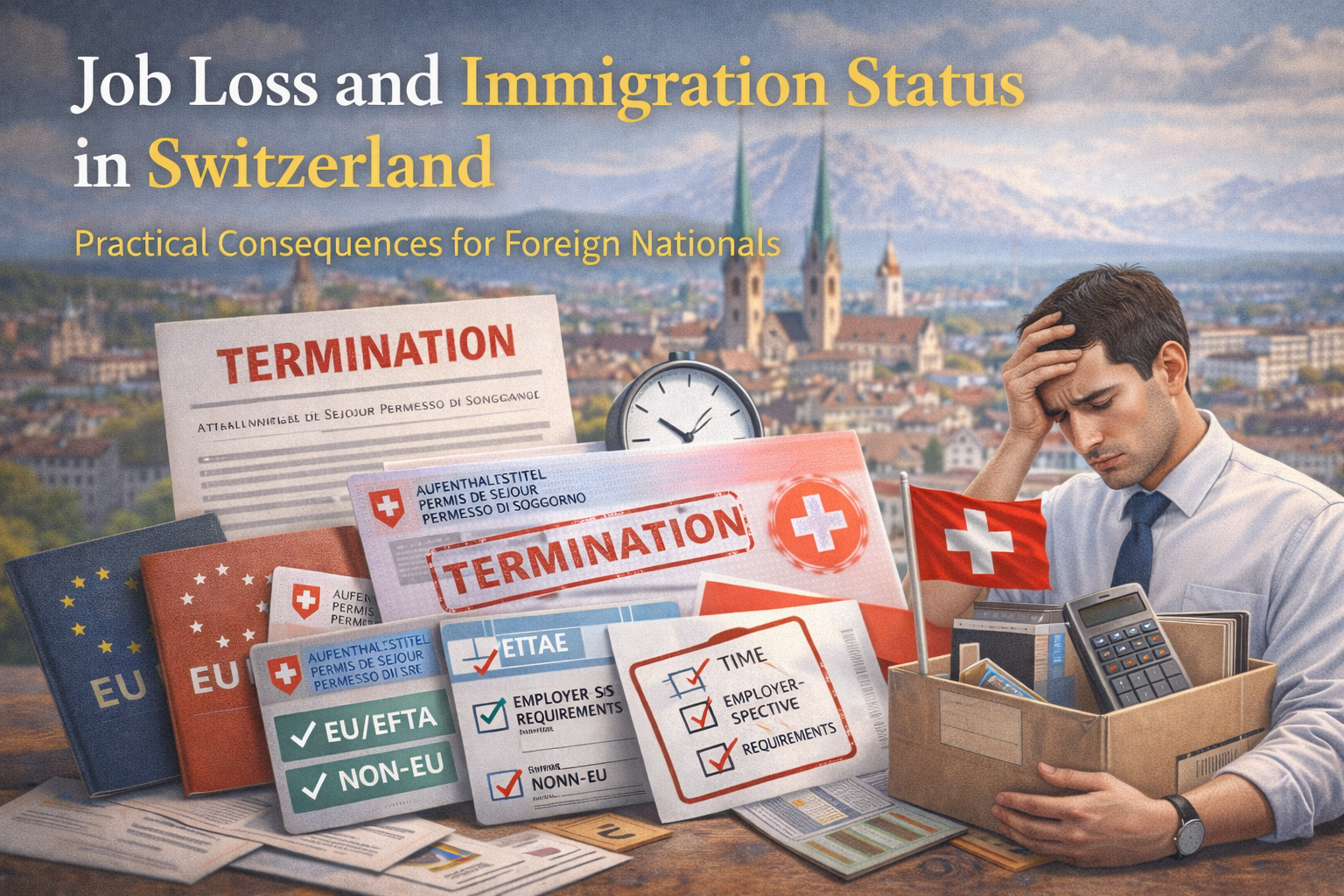
Losing a job is a major professional event. For foreign nationals in Switzerland, it can also raise immediate immigration questions, often misunderstood, and sometimes underestimated.
Contrary to common belief, job loss does not automatically lead to loss of residence rights. However, it does trigger a change of legal context that requires attention and timely action.
Job loss does not mean immediate loss of residence
In Switzerland, a residence permit is not withdrawn the day employment ends.
Foreign nationals are generally allowed to:
-
remain in Switzerland for a certain period,
-
look for new employment,
-
and, in some cases, change employers or professional status.
The exact implications depend on:
-
the type of permit,
-
nationality (EU/EFTA vs non-EU),
-
length of residence,
-
and overall personal situation.
EU/EFTA nationals: flexibility, but not immunity
EU/EFTA nationals benefit from freedom of movement, which provides greater flexibility after job loss.
They may remain in Switzerland while seeking new employment, provided they:
-
are genuinely available for work,
-
comply with registration and job-search requirements,
-
and do not create long-term dependency risks.
That said, prolonged unemployment or lack of genuine job-seeking activity can still raise issues.
Non-EU nationals: closer scrutiny
For non-EU nationals, job loss often has more direct immigration consequences.
Residence permits are typically:
-
employer- and role-specific,
-
linked to labour market approval,
-
and assessed against economic interest criteria.
After termination, authorities may:
-
limit the time allowed to find a new qualifying position,
-
reassess whether a new role meets permit requirements,
-
or, in some cases, question continued residence.
Timing and positioning are critical.
What often creates problems in practice
Difficulties usually arise not from the dismissal itself, but from:
-
delayed or incorrect communication with authorities,
-
assumptions based on informal advice,
-
missing deadlines to secure a new role,
-
or misunderstanding what changes must be reported.
In immigration matters, inaction can be as risky as the event itself.
Conclusion
Being laid off in Switzerland does not automatically end a foreign national’s right to stay but it changes the rules of the game.
Key questions include:
-
What type of permit is held?
-
How much time is available to find new employment?
-
Does the new role qualify under immigration rules?
-
Are next steps taken in a timely and structured way?
With early assessment and informed action, many situations remain manageable and lawful. Without it, otherwise solid cases can deteriorate quickly.
Article by Ara Samuelian
Samuelian Immigration Law (SIL) can support you all the way and in assessing the potential impact and help you build a strategy.
Get in touch and Contact SIL for guidance or case-specific advice.
Follow our LinkedIn Page and subscribe on our website to receive our newsletter with exclusive content !