
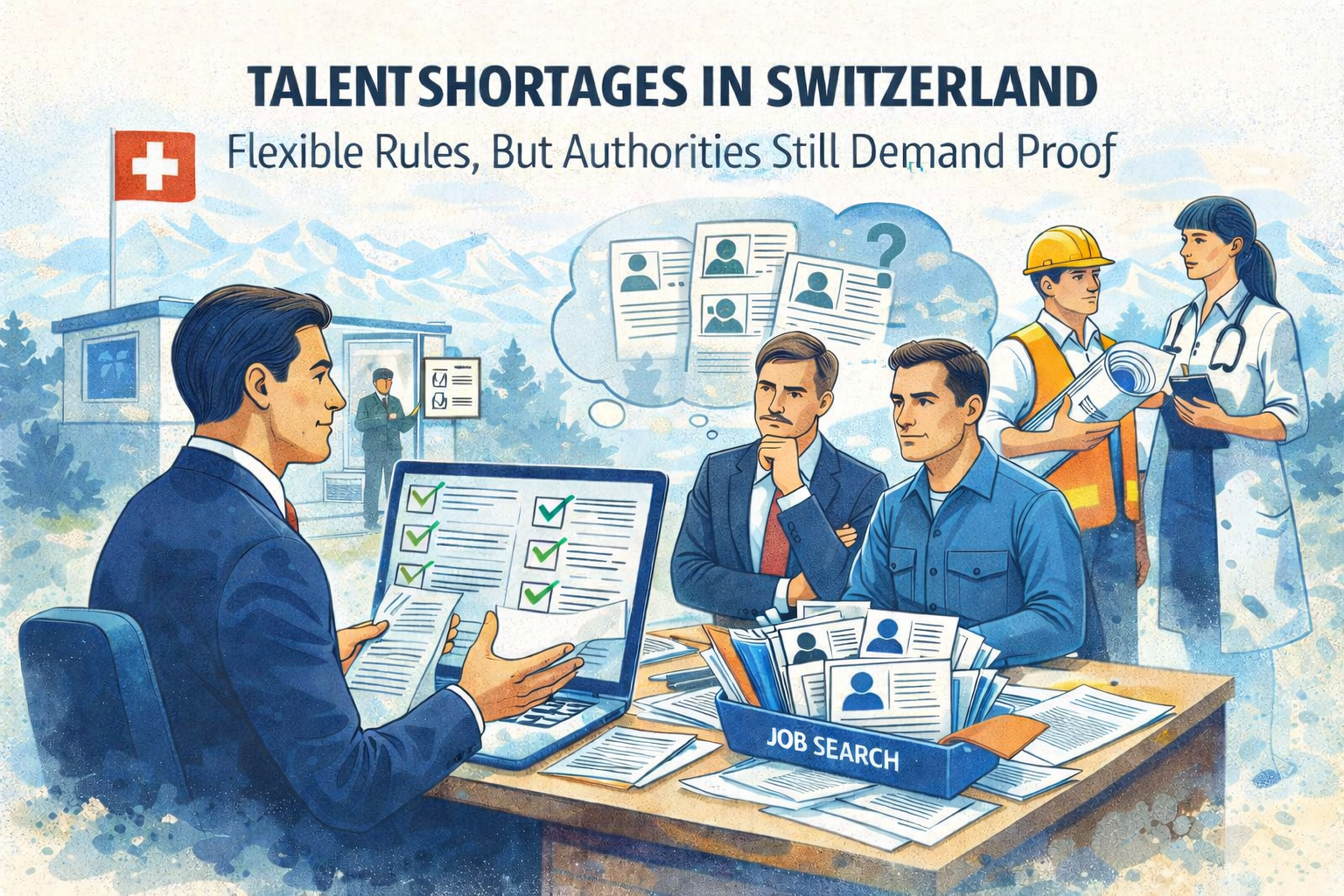
Hiring outside the EU/EFTA is possible, but preparation remains key.
Switzerland is facing a structural shortage of skilled workers in many sectors. In response, Swiss immigration rules allow for greater flexibility when employers recruit non-EU/EFTA nationals for roles where qualified talent is clearly scarce.
On paper, this looks encouraging. In practice, however, authorities continue to apply these rules cautiously and on a case-by-case basis.
What the law says: flexibility, not an automatic right
According to the Swiss State Secretariat for Migration (SEM), when a profession is clearly affected by a long-term skills shortage, authorities may assume that the local and EU/EFTA labour market has already been exhausted.
In such cases:
-
employers may not be required to provide extensive proof of recruitment efforts;
-
it can be sufficient to show, in a credible and practical way, that the role falls within a shortage profession;
-
the priority rule is then considered fulfilled.
Which professions are concerned
Based on labour-market indicators and real-life admission practice (Stand December 2025), flexibility is most often applied to roles in the following areas (note the list is updated on regular basis) :
- Senior and highly qualified roles
- Research & development, healthcare, education
- Information and communication technologies (IT)
- Consulting, finance and insurance
- Engineering, electrical equipment, metallurgy
- Chemical, pharmaceutical and food industries
- Business and analytical profiles
- Business economists
- Management and organisational analysts
- Engineering and IT specialists
- Engineers (industrial, civil, electrical)
- Technical specialists
- IT professionals: software engineers, system analysts, developers, data and network specialists
- Healthcare professionals
- Medical specialists and junior doctors
- Physiotherapists
- Specialised nursing staff
- Medical technicians (e.g. radiology)
- Higher education
- University and higher-education professors
This list is regularly updated and may evolve over time.
What really matters in practice
Even when a role is clearly in a shortage field, cantonal authorities still have wide discretion.
Depending on:
-
the local labour-market situation,
-
regional economic priorities,
-
or the overall economic interest,
they may still ask employers to:
-
advertise the position with the regional employment office;
-
show recruitment efforts in the EU/EFTA;
-
provide targeted evidence explaining why suitable candidates could not be found.
In addition, the job vacancy notification obligation remains fully applicable in all cases.
Key takeaways for employers
- ✔️ Skills shortages are recognised, but not applied mechanically.
- ✔️ Guidelines do not always reflect day-to-day practice.
- ✔️ The burden of proof remains with the employer, even in shortage occupations.
- ✔️ Authorities may still request recruitment efforts, depending on the case.
- ✔️ A well-prepared, realistic application significantly increases approval chances.
Our approach
At Samuelian Immigration Law, we support employers with a:
-
Pragmatic understanding of how the rules are applied in real life;
-
Proactive preparation of immigration files, aligned with local practice;
-
Partnership-driven approach with HR, leadership teams.
Hiring in a shortage occupation does not remove the need to prove — it changes how you prove it.
Article by Ara Samuelian
Does your organisation have plans of future hires or international transfers ?
Samuelian Immigration Law (SIL) can support you in assessing the potential impact and adjusting your workforce and mobility strategy.
Get in touch and Contact SIL for guidance or case-specific advice.
Follow our LinkedIn Page and subscribe on our website to receive our newsletter with exclusive content !