
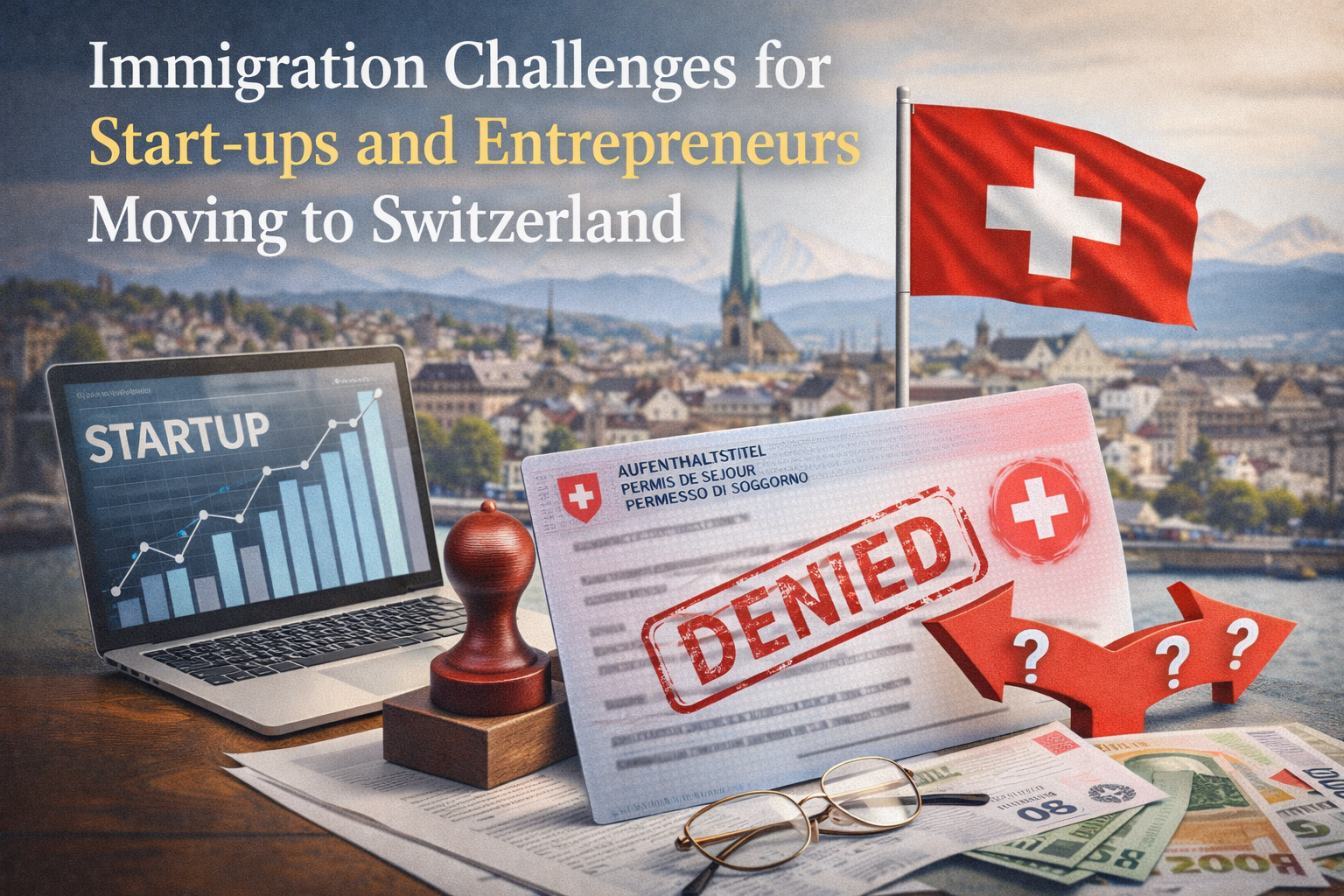
Switzerland is often seen as an attractive destination for start-ups and entrepreneurs: political stability, strong infrastructure, access to capital, and a business-friendly reputation.
Yet when it comes to immigration, many founders discover that the system is less flexible than expected, especially for non-EU nationals.
Understanding how immigration rules intersect with entrepreneurship is essential to avoid delays, refusals, or costly restructuring.
1. Switzerland welcomes businesses — but not all founder profiles equally
Swiss immigration law is not designed around the concept of “start-up founders” as a standalone category.
Instead, residence rights are assessed through existing legal frameworks, mainly:
-
employment-based permits,
-
self-employment permits,
-
family-related permits.
For entrepreneurs, this means that the business project alone is not enough. Authorities focus on whether the individual’s presence serves a demonstrable economic interest for Switzerland.
2. EU vs non-EU founders: a fundamental difference
For EU/EFTA nationals, the process is relatively straightforward.
Residence is generally granted if:
-
economic activity is genuine,
-
financial independence is demonstrated,
-
the business is viable.
For non-EU founders, the bar is significantly higher.
Authorities typically require proof that the project:
-
creates economic value in Switzerland,
-
contributes to innovation or employment,
-
is financially sustainable,
-
and cannot easily be carried out without the founder’s physical presence.
This assessment is discretionary and often conservative.
3. The “chicken-and-egg” problem
One of the most common frustrations for founders is timing.
Authorities may ask for:
-
an incorporated company,
-
signed contracts,
-
financing or revenue projections,
while investors or partners may expect:
-
a residence permit,
-
legal certainty,
-
physical presence in Switzerland.
Without careful planning, founders risk being stuck between business and immigration requirements that depend on each other.
4. Salary expectations and personal sustainability
Unlike some start-up ecosystems, Switzerland places strong emphasis on:
-
financial independence,
-
realistic remuneration,
-
avoidance of social assistance risk.
Founders who plan to:
-
pay themselves little or nothing,
-
rely solely on future funding,
-
or live off savings indefinitely,
may face difficulties convincing authorities of the project’s viability.
The immigration analysis is therefore closely linked to personal sustainability, not just corporate ambition.
Conclusion
Switzerland can be an excellent base for start-ups and entrepreneurs — but immigration is rarely automatic.
For founders, the key questions are not only:
-
Is my business viable?
but also:
-
Does my profile fit the immigration framework?
-
How will authorities assess my personal role and sustainability?
Aligning immigration strategy with business planning from the outset is often what determines whether a relocation to Switzerland is smooth — or significantly delayed.
Article by Ara Samuelian
Planning to build a new company or move to Switzerland as a Founder ?
Samuelian Immigration Law (SIL) can support you all the way and in assessing the potential impact and help you build a strategy.
Get in touch and Contact SIL for guidance or case-specific advice.
Follow our LinkedIn Page and subscribe on our website to receive our newsletter with exclusive content !